
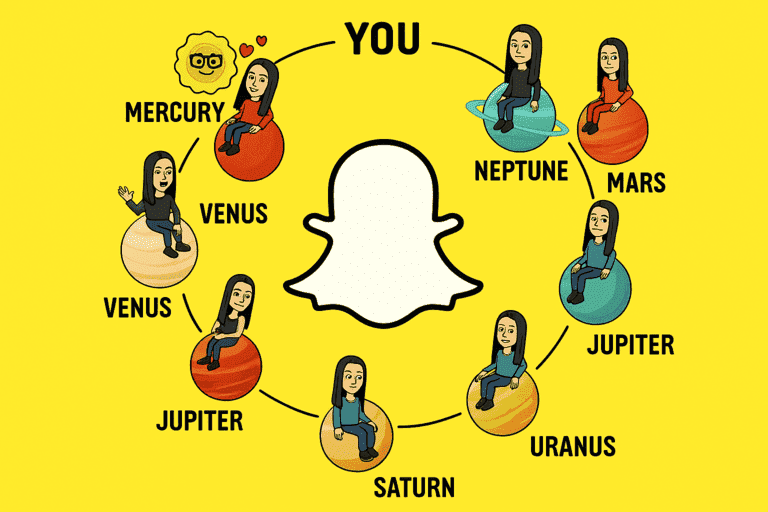
If you've spotted little planets next to your friends on Snapchat, you've found the Snapchat best friends planets feature — Snapchat+'s playful way of visualizing your best friends list as a solar system. Each planet shows where a friend ranks in how often you interact, with you as the sun at the center. It's fun, but it also causes plenty of confusion about what each planet means and who can see it. This guide breaks down the full Snapchat planets order, what your best friends list planets actually reveal, and the biggest myths to ignore.
What Is Snapchat+?
Snapchat+ is Snapchat's premium tier, launched in 2022, offering exclusive experimental features before they roll out to everyone. The subscription typically costs between $3 and $7 per month depending on region, with cheaper annual plans and localized discounts (users in Asia or Turkey often pay less).
Free users can keep snapping as usual, but Snapchat+ members get early access to advanced personalization tools and relationship insights — including the best friends planets feature that turns your best friends list into a solar system.
Key Features of Snapchat+
Here's what subscribers can unlock:
- Friend Solar System (Snap Planets) – See your best friends list ranking visualized as planets orbiting your Bitmoji sun.
- Story Rewatch Count – Find out who watched your story multiple times.
- Ghost Trail – View a friend's movement trail on Snap Map over the last 24 hours.
- Custom App Icons & Chat Wallpapers – Change Snapchat's appearance to fit your mood.
- Remove AI or Ads – Hide the My AI chatbot and remove sponsored interruptions.
- Pin Best Friend & Custom Notification Sounds – Keep your favorite person at the top with a unique alert tone.
- Priority Story Replies – Make sure creators see your responses first.
Among all these add-ons, the most talked-about by far is the Snapchat best friends planets feature — your best friends list, reimagined as a galaxy where you're the sun and your closest friends orbit as planets. It's cute, but it's also where most of the confusion comes from.
Snapchat Best Friends Planets: Full Order & Meaning
The best friends planets (officially the Friend Solar System) represent how often you interact with someone on Snapchat — measured through Snaps, chats, and general activity. The closer the planet, the stronger the interaction. The full Snapchat planets order, from closest to furthest, is:
- Mercury (#1) → Venus (#2) → Earth (#3) → Mars (#4) → Jupiter (#5) → Saturn (#6) → Uranus (#7) → Neptune (#8)
Here's a full breakdown of each planet in your best friends list, what it means, and the myths people get wrong:
🪐 Snapchat Planets Order Overview
| Planet | Ranking Position | Meaning / Description | Common Misunderstanding | Reality Explained |
|---|---|---|---|---|
| Mercury | #1 | Your closest friend — you exchange the most Snaps and chats. | "If someone is my Mercury, I must be theirs too." | ❌ Not always. Each Solar System is independent. You might be their Venus or Jupiter. |
| Venus | #2 | Second closest friend — frequent interaction, but not the top spot. | "Only one person can be Venus." | ❌ You can appear as Venus in several people's systems simultaneously. |
| Earth | #3 | Third on the list — consistent communication but less frequent. | "Planets represent mutual rankings." | ❌ Rankings are one-way; your view ≠ theirs. |
| Mars | #4 | Fourth closest friend — still active, but starting to drift. | "Once I'm Mars, I can't change." | ❌ Rankings fluctuate with interaction activity. |
| Jupiter | #5 | Mid-level friendship — casual Snaps or occasional chats. | "Lower planets mean weak ties." | ⚠️ Not necessarily — it's only about frequency, not emotional closeness. |
| Saturn | #6 | Sixth place — still in your Best Friends list but less active. | "You can't have multiple planets of the same rank." | ❌ Several friends can see you as the same planet at once. |
| Uranus | #7 | Seventh — rare communication but some recent history. | "Turning off the Solar System hides everything." | ❌ Turning it off only hides your view; others can still see their planet if they have Plus. |
| Neptune | #8 | Eighth — least active among your top friends. | "The black star means someone's watching my planets." | ❌ The ★ only shows that the user subscribes to Snapchat+ (not spying). |
🌞 How the Best Friends Planets System Works
- You are always the sun. Every person has their own independent solar system. Yours doesn't affect anyone else's.
- Interaction frequency = orbital distance. The more Snaps and messages exchanged, the closer the planet appears.
- Dynamic updates. Rankings change based on recent activity — miss a few days, and your planet may shift outward.
- Visibility rules. Turning off the Solar System only hides it for you; others can still see their planet in your system.
- The black star (★). It simply marks a Snapchat+ subscriber — not someone spying on you.
In short, the Snapchat best friends planets feature is a gamified friendship ranking that turns social interaction into a cosmic metaphor. It's not mutual, not fixed, and not a test of loyalty — just an algorithmic reflection of how often you snap and chat. If you're curious about related signals, see our guides on the green dot on Snapchat and how to tell if someone is active on Snapchat.
Common Questions and Misunderstandings
Even though it looks simple, many users get confused about how the best friends list planets actually work. Here are the most common questions — and the real answers.
1. Are both sides' planets the same?
- ❌ No. Each person has their own independent solar system, and the order you see is not mutual.
Example: You might see someone as your Mercury (#1), but on their side, you could be their Venus, Jupiter, or even Neptune. The ranking is calculated separately for every account, based purely on your interaction data — Snaps sent, chats opened, and story views.
2. Can multiple people share the same planet?
- ✅ Yes. You can appear as Mercury in several people's solar systems at once if you're their top friend. Planets aren't exclusive positions — they reflect where each person places you individually.
This is why you may have multiple friends showing as the same planet. It doesn't mean something is broken — it just means your interaction frequency with those people is similar.
3. If I turn off the Solar System, can others still see me?
- ✅ Yes, they can. Turning off the feature only hides the Solar System for you, not for others.
- If your friends have Snapchat+ and keep the feature enabled, they can still see their planet placement in your system.
Disabling it stops you from viewing planets — but it doesn't erase the data on their side. That's why someone may still see themselves as your Mercury even after you switch the feature off.
Features like Snapchat+ and best friends planets make social apps fun, but they also reveal how much time young users spend chatting online. If you're a parent who wants a clearer picture of your child's activity without invading their space, VigilKids offers a gentle, supportive approach — and for Snapchat specifically, see our guide to Snapchat parental controls.
VigilKids Pro
- Monitor your child's Snapchat activity with real-time screenshots and screen recordings
- Check WhatsApp chats, SMS, call logs, and shared media in one dashboard
- Set screen-time limits and get instant alerts for risky keywords or strangers
- Track GPS location and route history with geofencing alerts
- Focuses on awareness, not control — spot risks early without breaking trust
FAQs About Snapchat Best Friends Planets
Q1: What is the order of the Snapchat best friends planets?
From closest to furthest, the order is Mercury (#1), Venus (#2), Earth (#3), Mars (#4), Jupiter (#5), Saturn (#6), Uranus (#7), and Neptune (#8). The closer the planet, the more you interact with that friend.
Q2: What does it mean if I'm someone's Mercury?
Being someone's Mercury means you're their #1 best friend — you exchange the most Snaps and chats with them. It doesn't automatically mean they're your Mercury too, since each person's list is independent.
Q3: Do I need Snapchat+ to see the best friends planets?
Yes. The Friend Solar System is a Snapchat+ feature, so you need the paid subscription to see which planet your friends are. Without it, you can still have a best friends list, just not the planet visualization.
Q4: Why does the black star (★) appear next to a planet?
The black star simply indicates that the person is a Snapchat+ subscriber. It does not mean they're watching or spying on your planets.
Q5: Can my best friends list planets change?
Yes. Rankings update dynamically based on recent interaction. If you snap and chat less with someone, their planet drifts outward; if you interact more, it moves closer.
Conclusion
The Snapchat best friends planets feature transforms your everyday best friends list into a colorful galaxy. It's fun, symbolic, and sometimes confusing — but it was never meant to define real relationships. You are the sun, your friends are planets, and their distance only reflects how often you talk, not how much you care.
So whether you're someone's Mercury today or Neptune tomorrow, remember: the system changes with your activity, not your worth. It's just Snapchat's cosmic way of keeping your social orbit spinning. 🌞🌌
And if all those planets have you wondering just how much time your child spends on Snapchat, VigilKids can help you stay informed — with Snapchat activity insights, screen-time tools, and real-time alerts that keep families safe without breaking trust.
Related Topics
Best Alternatives to Snap | Apps Like Snapchat in 2026
Looking for alternatives to Snap? Discover the best apps like Snapchat and apps similar to Snapchat for private chats, filters, and messaging.
Snapchat Cheating: 10 Real Signs & Ways to Check
10 signs your partner may be cheating on Snapchat, how to spot a hidden second account, and lawful ways to get clarity—including Snapchat's own data tool.
9 Best Anonymous Snapchat Story Viewers 2026
Want to view Snapchat stories anonymously? Compare the 9 best Snapchat story viewers of 2026 — features, safety, and how to watch without being seen.