
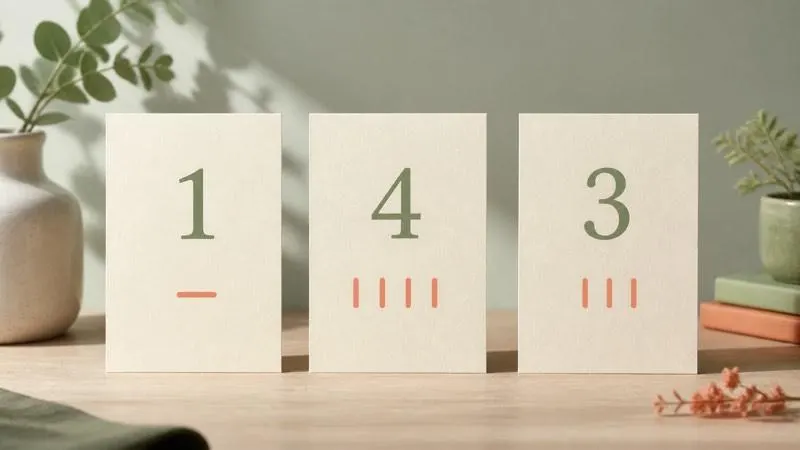
1 4 3 means “I love you” in a text message. Each digit counts the letters in one word: “I” has 1 letter, “love” has 4, and “you” has 3. People send 143 as a short, affectionate code in texts, DMs, captions, and comments. It is usually harmless, but the relationship and surrounding conversation determine whether the message is romantic, friendly, or family affection.
This guide explains what 143 stands for, where the code came from, how people use and answer it, and what parents should look at before drawing conclusions from one number.
01. What Does 143 Mean?
143 stands for “I love you.” It is a numeronym: a number used to represent a word or phrase. The code works by counting letters rather than matching numbers to alphabet positions.
| Digit | Word | Why it matches |
|---|---|---|
| 1 | I | One letter |
| 4 | Love | Four letters |
| 3 | You | Three letters |
The decisive clue is the phrase itself: 1 + 4 + 3 maps neatly to I + love + you. That is why the meaning of rage bait or a symbol such as the worm emoji cannot be decoded with the same rule; those terms depend on culture and context rather than letter counts.
02. What Does 143 Mean in a Text Message?
In a text message, 143 is a compact way to express love or affection. A partner might send it as a romantic sign-off, a parent may text it to a child, and close friends may use it warmly or playfully. The code does not reveal the relationship by itself.
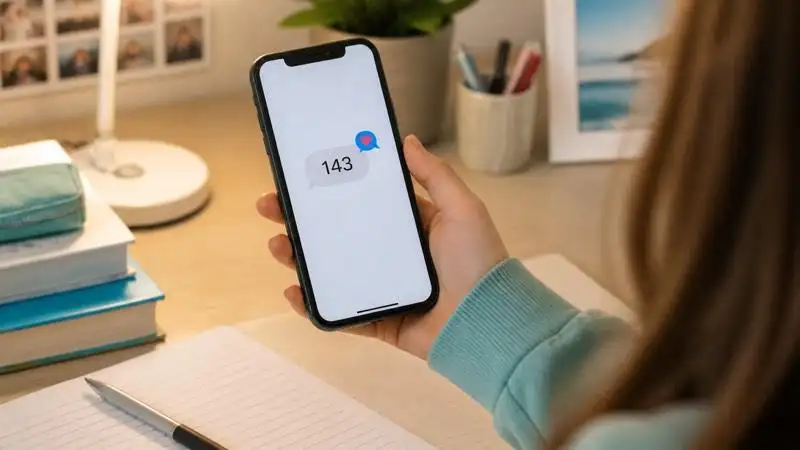
Example:
“Good luck on your test today. 143!” means “Good luck on your test today. I love you!” The supportive sentence makes family or friendly affection more likely than a secret romantic message.
The meaning is generally the same across iMessage, WhatsApp, Snapchat, Instagram, TikTok, and other chat platforms. An app does not assign a special definition to the number. Read who sent it, what came before it, and the tone of the exchange. As with text read indicators, one isolated signal gives less information than the full conversation.
03. Where Did 143 Come From?
143 became widely associated with “I love you” during the pager era of the late 1980s and 1990s. Many pagers displayed numbers more easily than full text, so users developed short numeric codes for common messages. Dictionary.com documents 143 as a pager-era code that later carried into chat rooms and texting.
An older story connects 143 with Minot’s Ledge Lighthouse in Massachusetts. Its light pattern used one flash, then four, then three. According to the story, a lighthouse keeper’s family interpreted the sequence as “I love you.” The lighthouse tale is part of the code’s popular history, but the practical letter-count explanation is all a modern texter needs.
Fred Rogers also helped keep 143 in public memory. The number became closely associated with his message of kindness, and Pennsylvania observes the 143rd day of the year as 1-4-3 Day to encourage acts of kindness. These associations explain why the code can feel nostalgic to adults even when teens encounter it as fresh slang.
04. How Is 143 Used?
143 usually appears as a complete message, a sign-off, or an affectionate reply. It can be sincere, playful, nostalgic, or intentionally subtle.
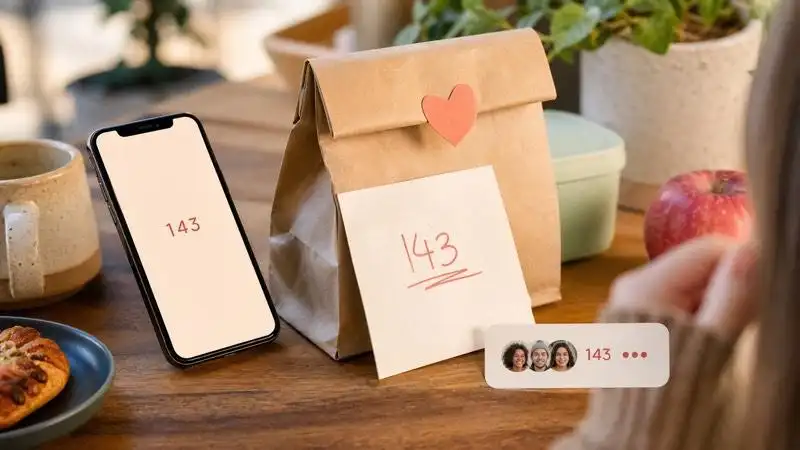
- Romantic: “Made it home safely. 143.”
- Family: “Sleep well, kiddo. 143.”
- Friendly: “Thanks for always showing up for me—143.”
- Playful: “You brought snacks? 143 forever.”
- Caption or comment: “143” beneath a photo of someone important.
Capitalization and spacing do not usually change the meaning: “143,” “1-4-3,” and “1 4 3” can all stand for “I love you.” Tone still matters. Sarcasm, an inside joke, or a reference to a song can change what the sender intends, so clarification is better than certainty when the exchange is ambiguous.
05. How Should You Reply to 143?
Reply according to your relationship and comfort level. You do not have to mirror “I love you” if that is not what you want to say.
- Return the feeling: “1432” or “I love you too.”
- Keep it warm: “That means a lot to me ❤️.”
- Clarify: “Do you mean ‘I love you’?”
- Set a boundary: “I care about you, but I’m not comfortable saying that yet.”
- Respond to an unknown sender: “Who is this?” without sharing personal details.
If a message comes from a stranger, do not assume the affectionate code makes the person trustworthy. The FTC advises families to keep details such as a child’s address, phone number, and physical location private online. The same caution is useful when assessing unfamiliar chat services, including whether TextNow is safe for a child or whether XChat is appropriate for teens.

06. What Do 1432 and 14344 Mean?
1432 commonly means “I love you too”: 143 supplies “I love you,” and 2 sounds like “too.” The longer code 14344 is often interpreted as “I love you very much,” because “very” and “much” each contain four letters.
| Code | Common meaning | Typical use |
|---|---|---|
| 143 | I love you | Affection or sign-off |
| 1432 | I love you too | Reply to 143 |
| 14344 | I love you very much | More emphatic affection |
These extensions are less universal than 143. If the longer code appears without context, ask the sender rather than treating an online glossary as proof of intent.
07. Should Parents Worry About 143?
143 alone is not a warning sign. It usually expresses affection and is not an instruction, threat, drug reference, or request for explicit content. Parents should focus on the sender, the age difference, the surrounding exchange, and whether the conversation includes pressure, secrecy, personal-data requests, sexual content, or attempts to move to a hidden channel.
- Step 1. Ask neutrally: “I saw 143 mentioned—what does it mean in your conversation?”
- Step 2. Listen before interpreting the relationship.
- Step 3. Discuss what information should remain private and what behavior would feel pressuring.
- Step 4. Escalate only when the wider pattern shows a real safety concern.
A family conversation is more useful than treating every code as evidence of danger. If a chat does become sexual, the risks and response should be addressed directly; this guide to sexting on Snapchat explains that separate issue.
For families that have a clear, age-appropriate monitoring agreement, VigilKids can help an authorized parent review supported message and social-app activity on a compatible child device and understand the context around unfamiliar terms. Check current device and app compatibility before setup, and use monitoring to support conversation rather than replace it.

- Review supported message and social-app activity with surrounding context
- Use keyword alerts for terms relevant to your family’s safety plan
- Bring patterns into calm, informed parent-child conversations
08. Frequently Asked Questions
Is 143 always romantic?
No. 143 means “I love you,” but the love may be romantic, familial, or friendly. The sender, relationship, and surrounding message reveal the likely tone.
What does 143 mean from a girl or a guy?
It means “I love you” regardless of the sender’s gender. Whether the message is romantic depends on the relationship and conversation, not on whether a girl or guy sent it.
Does 143 mean the same thing on Snapchat and TikTok?
Usually, yes. On Snapchat, TikTok, Instagram, WhatsApp, and ordinary texts, 143 commonly stands for “I love you.” A song reference or inside joke may add another layer.
What is the difference between 143 and ILY?
Both mean “I love you.” ILY uses the phrase’s initials, while 143 represents the number of letters in each word. The choice is stylistic.
09. Final Takeaway
143 means “I love you”: one letter in I, four in love, and three in you. It is an old pager code that still appears in modern texts and social media. Read the full exchange to decide whether the affection is romantic, friendly, or familial, and ask when the intent is unclear. Parents should treat 143 as a conversation cue, not a danger signal. Families that need more context under a transparent safety agreement can explore VigilKids parental controls.
10. Authoritative Sources
- Dictionary.com: 143 slang meaning and pager-era history (checked August 18, 2026)
- TIME: 143 Day and Fred Rogers’ association with the number (checked August 18, 2026)
- Federal Trade Commission: Protecting Your Child’s Privacy Online (checked August 18, 2026)
Hot Topics
What Does ASL Mean? Text, Slang, Snapchat, and Sign Language
Learn what ASL means in texts, Snapchat, and slang, how to distinguish “age, sex, location” from “as hell,” and when ASL means sign language.
How to Play FNF Unblocked Safely on Any Device
Learn how to play FNF unblocked safely on a Chromebook or personal computer, fix loading problems, avoid risky sites, and set healthy gaming rules.

10 Online Safety Tips: How to Stay Safe Online in 2026
Discover 10 practical online safety tips to protect your accounts, avoid scams, secure devices, safeguard privacy, and help children stay safe online.