
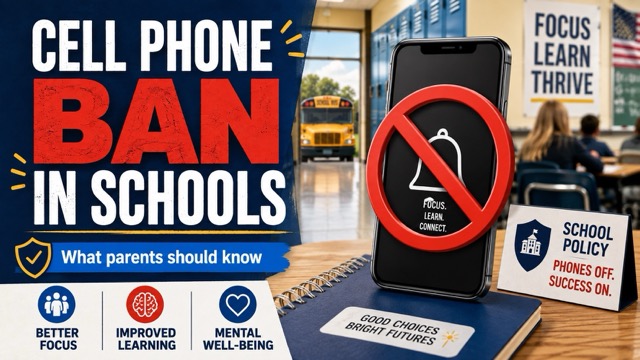
Back-to-school season in 2026 feels different for many U.S. families: a cell phone ban in schools is becoming a written law, board policy, or bell-to-bell rule in more states and districts. The trend is no longer only local; Education Commission of the States reported in July 2026 that at least 40 states had enacted policies related to cell phone use in schools. For parents, the real question is how daily contact, bus rides, sports pickup, health needs, and after-school screen time are supposed to work under the new rules.
The practical answer is that most school phone policies restrict student access during the school day, but they still leave room for emergencies, documented accommodations, medical needs, and official parent-school communication. In this guide, you will learn what these bans usually mean, how to check state and district rules, and how to build a family phone plan for contact, commutes, homework, and sleep.
Why Phone Bans Are Expanding in 2026
Schools are not acting in isolation. UNESCO reported in March 2026 that 114 education systems, or 58% of countries worldwide, had national bans on mobile phones in schools. The stated concerns are familiar to most parents: distraction, cyberbullying, student well-being, and the difficulty of keeping learning time focused when every pocket can buzz.
The U.S. picture is more fragmented because education policy is split across states, districts, and schools. Still, the direction is clear. Education Commission of the States says at least 40 states have enacted policies related to cell phone use in schools. NCES also reported that 77% of U.S. public schools had a policy prohibiting students from having cell phones during any classes, while 38% of schools with a policy prohibited use in situations outside class. In other words, the practical question is not just “is there a ban?” but “when, where, and how is it enforced?”
What this means for parents
- The rule may be new even if the concern is old. Many schools discouraged phones before, but now more policies are formal and enforceable.
- “Ban” does not always mean the same thing. A classroom rule, bell-to-bell rule, and campus-wide rule create different contact problems.
- Family routines still matter. A school can limit phones from first bell to dismissal, but it cannot manage homework scrolling, late-night notifications, or pickup routines at home.
That last point is the parent opportunity. Instead of arguing about the entire national debate, focus on the everyday system your child needs: where the phone goes at school, how they contact you, and what happens after the phone comes back.
What parents and teachers are actually worried about
- Teachers want consistency: phone bans work better when administrators support the rule instead of leaving enforcement to individual teachers.
- Parents want contact plans: emergency contact, bus rides, sports pickup, and after-school check-ins need a clear backup system.
- Students test loopholes: hidden phones, smartwatches, earbuds, and “just checking the time” habits are common friction points.
- The home routine still matters: even a strong school policy does not solve homework scrolling, late-night notifications, or after-school app use.
What a Cell Phone Ban in Schools Usually Means
A phone ban in schools is a policy that limits when students can possess, access, or use personal devices during the school day. It may include phones only, or it may also cover smartwatches, earbuds, tablets, and other electronic communication devices.
The main difference is scope. Parents should read the school handbook for these four policy types:
| Policy type | What it usually means | Parent action |
|---|---|---|
| Instructional-time limit | Phones are away during class but may be allowed at lunch or between periods. | Ask when your child can check messages after class. |
| Bell-to-bell ban | Phones are inaccessible from the first bell to dismissal, often including lunch. | Use office, nurse, coach, or transportation contacts during the day. |
| Storage rule | Phones go in backpacks, lockers, classroom holders, pouches, or the office. | Confirm what happens if a student forgets or refuses. |
| Campus-wide restriction | Personal devices cannot be used on school property unless an exception applies. | Document medical, disability, language, or safety exceptions early. |
Most policies also include exceptions. Common examples include documented medical monitoring, disability accommodations, IEP or 504 needs, emergencies, translation or language access, and teacher-approved learning activities. If your child needs a phone for a health app, glucose monitor, assistive technology, or safety plan, ask the school how that exception is documented before the policy causes a conflict.
A good parent sentence to use with the school is: “I understand the phone rule. Can you show me the written process for parent contact, emergencies, and documented exceptions?” This keeps the conversation practical rather than adversarial.
What States Have Banned Cell Phones in Schools?
There is no single U.S. no phones in school law. Instead, states are passing different kinds of laws and requirements, while districts write the local school cell phone policy that families actually follow. That is why two neighboring districts can feel very different even when they are responding to the same state trend.
According to Education Commission of the States, state approaches vary by scope and implementation. Some states require local education agencies to create cell phone policies, while others move toward instructional-time or bell-to-bell restrictions. State laws and district policies often define when students may access phones and list exceptions for health, special education, emergencies, language or translation needs, and educator discretion.
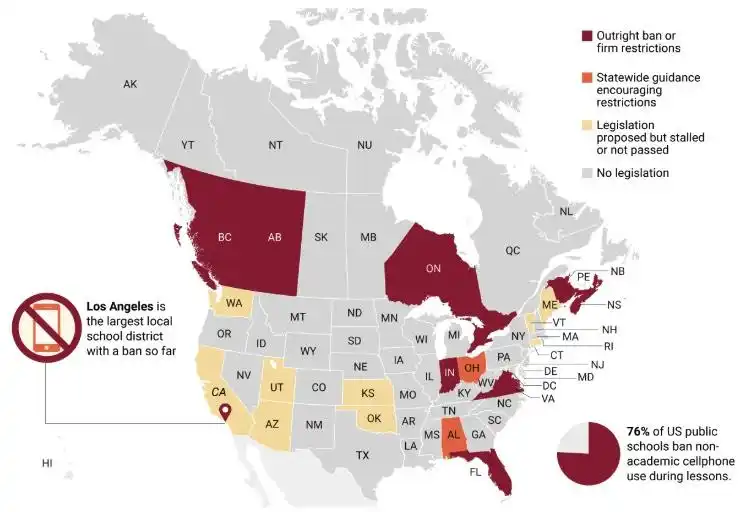
For parents searching “what states have banned cell phones in schools,” the safest answer is to check both state and district sources. States such as Ohio, Texas, Georgia, New Jersey, Florida, Indiana, Louisiana, New York, Virginia, Oklahoma, Utah, and others have appeared in 2025–2026 policy discussions or enacted-law trackers, but the rule details are not identical. Some focus on instructional time. Others move toward bell-to-bell restrictions. Some apply by grade band. Some let parents request brief accommodations in specific areas of the school.
Quick check before you assume
- Search your district name plus student cell phone policy.
- Look for whether the policy says instructional day, school day, or bell-to-bell.
- Check whether smartwatches and earbuds are included.
- Save the school office and transportation contact before the first day the rule is enforced.
This approach also avoids a common SERP trap: many articles list states, but parents still need the local version. The district handbook is where you find whether the phone is stored in a locker, pouch, backpack, or office, and what happens after a first or repeated violation.
How Parents Can Contact Kids During a School Phone Ban
Parents can usually contact a child during a school phone ban by using the school’s official contact channels: the main office, attendance office, nurse, transportation office, after-school program, coach, or club sponsor. The important step is to save those contacts before the first day the rule is enforced, not during a stressful moment.
The hardest part of a cell phone ban in schools is contact anxiety. Parents want reassurance; schools want fewer distractions and fewer hallway crises caused by mass texting. The workable middle ground is to separate ordinary contact from urgent contact.
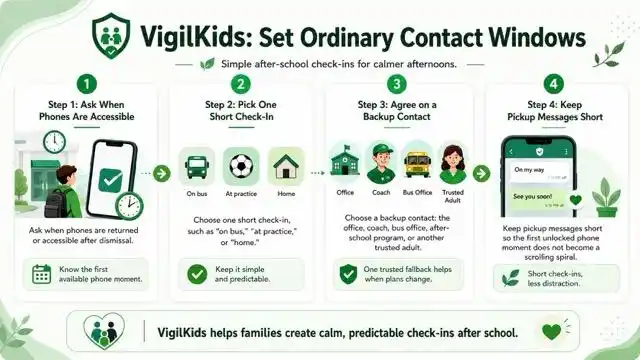
Set ordinary contact windows
- Step 1. Ask when phones are returned or accessible after dismissal.
- Step 2. Choose one short check-in, such as “on bus,” “at practice,” or “home.”
- Step 3. Agree on a backup contact: the office, coach, bus office, after-school program, or another trusted adult.
- Step 4. Keep pickup messages short so the first unlocked phone moment does not become a scrolling spiral.
Use the adult system for emergencies
For true emergencies, schools generally want parents to contact the main office instead of texting a student directly. That can feel slower, especially during a stressful news alert, but it helps staff verify information and avoid confusion. Save the main office, nurse, attendance line, transportation office, after-school program, coach, and club sponsor contact in one shared family note.
Then say the quiet part out loud to your child: “If you feel sick, unsafe, or stuck, go to an adult. The phone rule is not more important than your safety.” Kids need to hear that because strict rules can make some students hesitate to ask for help. For families who rely on location check-ins after dismissal, a separate GPS tracker for kids routine can help clarify what belongs after school, not during class.
After-School Phone Rules: Where VigilKids Fits
A school phone ban may solve one part of the day, but it does not automatically solve the rest. Some kids come home and try to make up for restricted access with heavy scrolling. Others need the phone for the bus, a part-time job, sports pickup, or shared custody logistics. That is why the family plan should cover the hours after dismissal.
A parent-friendly rule of thumb is to divide phone use into four zones:
- School day: follow the school policy and use official contact channels.
- Commute: use one short check-in and a backup adult contact.
- Homework: keep distracting apps away until the first work block is done.
- Bedtime: charge the phone outside the bedroom or use a family charging station.
Where VigilKids fits
This is where a tool like VigilKids can make sense—not to get around school rules, but to help parents keep after-school device routines visible and consistent. Families can pair school-day expectations with home routines for app use, location check-ins, and bedtime boundaries.
Keep the tone collaborative. A teenager is more likely to follow the plan when the rule is specific: “Text me when practice ends, then put your phone on the kitchen charger during homework,” not “You are always on that thing.” If homework is the daily battle, use a simple first-hour rule and then layer in time limits on apps only where the distraction actually happens.
A Parent Checklist for Your Child’s School Cell Phone Policy
Before you sign the handbook or argue with your teen about fairness, run through this checklist. It turns a big policy debate into a few concrete decisions.
- Find the exact rule: Is it bell-to-bell, instructional time only, or teacher-by-teacher?
- Check device scope: Does it include smartwatches, earbuds, tablets, school-issued devices, or only personal phones?
- Confirm storage: Backpack, locker, pouch, classroom holder, main office, or powered off and away?
- Document exceptions: Medical needs, IEP/504 accommodations, translation tools, and emergency access should be clear in writing.
- Plan contact: Save office, transportation, coach, and after-school contacts before you need them.
- Set home rules: Decide where the phone goes during homework and overnight.
- Review consequences: Ask what happens after a first, second, or repeated violation and when a parent must pick up the phone.
- Keep the tone practical: Tell your child the goal is learning and safety, not punishment or mistrust.
One final tip: do not frame the rule as “the school versus the family.” A healthier message is, “School handles learning time. We handle the rest of the day together.” That keeps your child from treating the policy as a power struggle and gives your family room to build reasonable independence.
FAQs
What does bell-to-bell phone ban mean?
A bell-to-bell phone ban usually means students cannot access personal phones from the first morning bell until final dismissal. It often includes lunch, passing periods, and breaks. Always check whether smartwatches, earbuds, buses, extracurriculars, and documented exceptions are included.
How can parents contact a child during a school phone ban?
Use the school’s official contact path: main office, attendance office, nurse, transportation office, after-school program, coach, or club sponsor. For non-urgent messages, agree on an after-dismissal check-in instead of expecting all-day texting.
How do I check my school cell phone policy?
Search the district website for “student cell phone policy,” “personal electronic device policy,” or “student handbook.” Then confirm when phones must be away, where they are stored, what exceptions are allowed, how parents contact students, and what happens after violations.
Can schools take your phone?
Schools often can temporarily confiscate a student phone when the student violates a valid school policy, but the details depend on state law, district rules, school handbook language, and due-process expectations. This is not legal advice; ask the school for the written policy and escalation steps.
What states have banned cell phones in schools?
State policies are changing quickly. Education Commission of the States reported in July 2026 that at least 40 states had enacted policies related to cell phone use in schools. Parents should still check the district policy because implementation, exceptions, and consequences vary.
Conclusion
A cell phone ban in schools is easier to handle when parents stop treating it as a yes-or-no debate and start treating it as a logistics plan. The useful work is finding the exact policy, documenting exceptions, saving official contact numbers, and deciding how your child will check in after dismissal.
The school can set the learning-time boundary, but your family still shapes the rest of the day: the commute, homework block, sports pickup, social time, and sleep. If the policy feels overwhelming, start with one calm rule this week, then adjust as your child’s schedule and maturity change.
 Sources
- UNESCO GEM Report: Phone bans in schools are spreading worldwide
- Education Commission of the States: How States are Evolving Cell Phone Policies in Schools
- NCES: More than Half of Public School Leaders Say Cell Phones Hurt Academic Performance
Source note: Reviewed on August 25, 2026. State laws, district policies, emergency procedures, accommodation rules, and device definitions can change by school year and location. This article is general information for parents, not legal advice.
You May Also Like
18 Games Not Blocked by School: Sites and Picks for 2026
Find games not blocked by school, safe browser sites, Chromebook tips, and parent checks for ads, privacy, downloads, and screen time.
Why Do Kids Skip School? Understanding the Real Reasons Behind Chronic Absences
Discover why kids skip school, the real causes behind it, and practical ways parents can respond with understanding instead of punishment.
Top Parental Control Apps 2026: iPhone, Android, Mac & PC
The top parental control apps in 2026 for every family type — by age, by platform, by household setup. Compare 7 picks including VigilKids, Bark, and Family Link.