

See VigilKids in Action
Watch how VigilKids helps parents monitor, protect, and stay connected with their child’s digital world in real time.
"It's 3 AM. Your baby's fever is climbing. You reach for the ibuprofen bottle — and freeze. Was it 1.25 mL or 2.5 mL? Is this the infant version or the children's? And what if you give too much?"
Every parent faces this moment. Infant ibuprofen is one of the most useful medicines in the house — and one of the easiest to dose wrong. The trap: infant drops and children's liquid look almost identical but have very different strengths. Mix them up and you can deliver 2-4× the intended dose.
This guide covers the correct infant ibuprofen dosage by weight and age, the difference between formulations, and the safety steps that matter before 3 AM hits.

 Note
Note
This article is for general education only. Always confirm the right dose for your child with your pediatrician or pharmacist. If you suspect you've given too much ibuprofen, call Poison Control at 1-800-222-1222 (in the US) immediately. Never give ibuprofen to a baby under 6 months without a doctor's specific instruction.
- Table Of Contents
- Part 1. Infant vs. Children's Ibuprofen: Understanding the Concentration Gap
- Part 2. Infant Ibuprofen Dosage Chart by Weight and Age

- Part 3. How to Measure Infant Ibuprofen Correctly
- Part 4. Real Parent Mistakes: What Happens When Dosage Goes Wrong
- Part 5. 6 Tips to Avoid Infant Ibuprofen Dosing Errors
- FAQs About Infant Ibuprofen
- Conclusion
Part 1. Infant vs. Children's Ibuprofen: Understanding the Concentration Gap
There are two main liquid ibuprofen products sold over the counter for kids in the US, and they are not interchangeable:
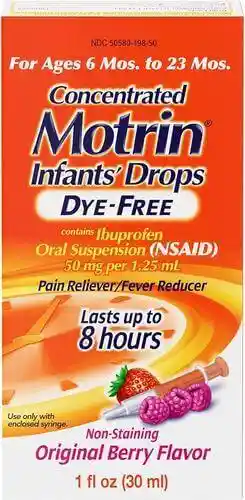
- Infant's ibuprofen drops — sold in small bottles, comes with a calibrated dosing syringe. Concentration: 50 mg per 1.25 mL.
- Children's ibuprofen liquid — sold in larger bottles, comes with a measuring cup or syringe. Concentration: 100 mg per 5 mL.
 Tips
Tips
The math that matters: 1 mL of infant ibuprofen drops contains twice as much medication as 1 mL of children's liquid. If you mistakenly give your baby 5 mL of infant drops thinking it's children's liquid, you'd be delivering roughly 4× the intended dose. This is the single most common dosing error parents make.
Both formulations are the same medication — ibuprofen — but they are designed for different age and weight ranges. Infant drops are formulated for babies 6 to 23 months, while children's liquid is intended for kids 2 to 11 years. The reason for the concentration difference is volume: a small baby can swallow a 1.25 mL syringe more easily than 5 mL, so the medication is more concentrated. This is why always reading the label before each dose is not optional — even if you've given the medicine before.
Part 2. Infant Ibuprofen Dosage Chart by Weight and Age
The American Academy of Pediatrics (AAP) and most US pediatric hospitals recommend dosing infant ibuprofen primarily by weight — age is only a backup if you don't know your child's current weight. The standard formula is 5–10 mg per kilogram of body weight, given every 6–8 hours, with a maximum of 4 doses in 24 hours.
Here is the dosing chart for Infant's Ibuprofen Drops (50 mg per 1.25 mL), based on AAP guidance:
| Child's Weight | Approx. Age | Recommended Dose | Frequency |
|---|---|---|---|
| Under 12 lbs (5.5 kg) | Under 6 months | Do NOT give unless directed by a doctor | — |
| 12–17 lbs (5.5–7.7 kg) | 6–11 months | 1.25 mL (50 mg) | Every 6–8 hours |
| 18–23 lbs (8.2–10.5 kg) | 12–23 months | 1.875 mL (75 mg) | Every 6–8 hours |
| 24–35 lbs (10.9–15.9 kg) | 2–3 years | 2.5 mL (100 mg) | Every 6–8 hours |
| 36–47 lbs (16.3–21.3 kg) | 4–5 years | 3.75 mL (150 mg) — switch to children's liquid | Every 6–8 hours |
Key dosing rules to memorize:
- Never exceed 4 doses in 24 hours.
- Wait at least 6 hours between doses.
- Use weight, not age, whenever you know your child's current weight — age is a backup only.
- Never give ibuprofen to a baby under 6 months without a doctor's specific instruction.
- Maximum 24-hour dose: 40 mg per kg of body weight.
Part 3. How to Measure Infant Ibuprofen Correctly
A wrong measuring tool is the second most common cause of dosing errors. Here's what works and what doesn't.
Use the Syringe That Came With the Medication
Infant's ibuprofen drops always include a small calibrated oral syringe. This is the only tool you should use for measuring infant doses. If the syringe is lost or damaged, ask your pharmacist for a replacement — they're often free.
Never Use Kitchen Spoons
Kitchen teaspoons and tablespoons vary in size by as much as 50%, which can mean the difference between an effective dose and a dangerous overdose. The Centers for Disease Control specifically warn against using kitchen utensils for medication dosing.
Read the Label Every Time, Even at 3 AM
Most dosing errors happen when a tired parent measures by memory rather than by reading the label. Concentration changes between brands and formulations are common — get in the habit of reading the strength line ("50 mg per 1.25 mL") every single dose.
Check the Concentration Before Buying
If the bottle you're holding says "100 mg per 5 mL", you have children's liquid — not infant drops. The packaging is intentionally different (smaller bottle for infants, larger for children's) but both can sit on the same store shelf. Buy with intention rather than reaching for the closest one.
Part 4. Real Parent Mistakes: What Happens When Dosage Goes Wrong
Even careful parents make infant ibuprofen dosing mistakes — especially when sleep-deprived during a fever night. Three patterns come up over and over in parent forums and Poison Control reports.
Using Infant Drops With the Children's Liquid Dose
The pediatrician says "give 4 mL of ibuprofen," assuming you have children's liquid at home. You open the infant drops instead and give 4 mL — that's 160 mg, double the intended 80 mg. Not usually dangerous, but still double. Always ask: "Do you mean infant drops or children's liquid?"
Giving a Second Dose Too Soon
Fever climbs again before the 6-hour mark, and a panicked parent gives a second dose at hour 3 or 4. Close-spaced doses rarely cause acute harm in healthy kids, but they push the daily total toward the 40 mg/kg ceiling. The fix: write down every dose and the exact time, somewhere visible like the fridge or a notes app.
Confusing Bottles in the Middle of the Night
Households with multiple kids often have both products in the cabinet. At 3 AM, half-asleep, a parent grabs the wrong bottle — infant drops to an older child (too weak), or children's liquid to a baby (too much). The fix: store the two formulations in separate places, syringe rubber-banded to its matching bottle.
The thread in all three: tired parents skipping the label. If any of these happens to you, call Poison Control — they've heard every scenario and can tell you within minutes whether home monitoring is enough or you need the ER.
Part 5. 6 Tips to Avoid Infant Ibuprofen Dosing Errors
The patterns above are preventable. These six habits, used together, dramatically reduce the chance of an infant ibuprofen dosage mistake.
Read the Concentration on the Label Every Time
Don't rely on memory. Every dose, check that you're holding the right product (infant drops vs. children's liquid) and confirm the concentration printed on the label matches what you remember.
Store Infant and Children's Versions Separately
If your household has both products, keep them in physically different locations — one on a high shelf, the other in a labeled drawer. Visual separation prevents grab-the-wrong-bottle mistakes at 3 AM.
Keep a Dosing Log
A small notepad on the fridge or a notes app on your phone works. Write down the time and amount of every dose. This protects against accidentally giving two doses too close together, and gives Poison Control or your pediatrician the exact information they need if something goes wrong.
Use the Original Syringe That Came With the Bottle
The syringe is calibrated to that specific concentration. Using a children's liquid measuring cup to dose infant drops is a recipe for confusion. If the syringe is missing, ask your pharmacist for a free replacement.
Double-Check With Another Adult When Possible
If a co-parent or another caregiver is in the house, ask them to verify the dose before you give it. This second pair of eyes catches surprisingly many errors, especially during illness when both of you are tired and stressed.
Save Poison Control in Your Phone Before You Need It
1-800-222-1222. Add the number to your phone contacts and your partner's contacts now, while your baby is healthy. In the panic of a real overdose, you don't want to be searching for the number.
FAQs About Infant Ibuprofen
Q1: How much infant ibuprofen can I give a 6-month-old?
For a 6-month-old weighing 12–17 lbs, the standard dose of infant ibuprofen drops (50 mg/1.25 mL) is 1.25 mL, given every 6–8 hours as needed for pain or fever. Do not exceed 4 doses in 24 hours. Always confirm with your pediatrician — and never give ibuprofen to a baby under 6 months without specific medical guidance.
Q2: Can I give ibuprofen to my 3-month-old?
Generally no. The FDA has not approved ibuprofen for infants under 6 months, and the AAP recommends against giving it without a doctor's specific instruction. For fever in younger babies, acetaminophen (Tylenol) is the more commonly recommended option — but again, only with pediatrician guidance for any infant under 3 months.
Q3: What's the difference between infant ibuprofen and children's ibuprofen?
The medication is the same (ibuprofen), but the concentrations differ. Infant drops contain 50 mg per 1.25 mL — twice as concentrated as children's liquid (100 mg per 5 mL). Infant drops are designed for ages 6–23 months and come with a smaller syringe; children's liquid is designed for ages 2–11 and comes with a measuring cup. Mixing them up is the most common cause of dosing errors.
Conclusion
Infant ibuprofen is one of the most useful medicines in the house — and one of the easiest to get wrong. The core habit: read the concentration on the label every time, and use the syringe that came with that specific bottle. Dose by weight when you know it, age as backup. Never give ibuprofen to a baby under 6 months without your pediatrician's go-ahead. And save Poison Control (1-800-222-1222) in your phone before you ever need it — free, calm, available 24/7. A few simple habits, and you can skip the 3 AM panic.
Note
This guide is for general education and does not replace medical advice. For any concern about your child's dose, fever, or symptoms, contact your pediatrician or call Poison Control at 1-800-222-1222.
Related Topics

Watch Cartoons Online Free: 10+ Best Websites for Kids
Discover 10+ best websites to watch cartoons online free safely. Learn age suitability, registration info, and protect kids with Vigilkids parental control.

Is Spotify Safe for Kids? A Practical Guide for Parents in 2025
Is Spotify Safe for Kids? A Practical Guide for Parents in 2025

Free Fire Game Kids: What Makes It Popular—and Why Parents Should Be Concerned
Learn why kids love Free Fire, the hidden risks it may pose, and what parents and communities are saying about keeping children safe.